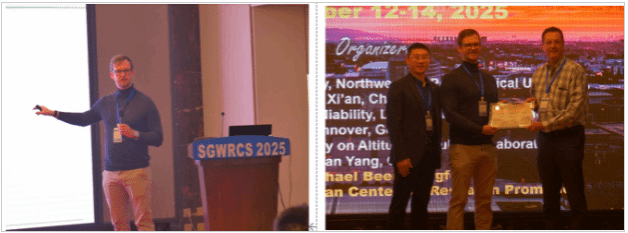
The 4th Workshop on Reliability of Complex Systems (SGWRCS 2025) was held at the Xi'an Guangcheng Hotel from November 12 to 14. Co-hosted by Northwestern Polytechnical University, the Hannover University in Germany, and the Key Laboratory of High Altitude Simulation Technology (Mianyang), this conference continued the specialized support from the National Natural Science Foundation of China's Sino-German Science Center International Cooperation Program (“Bayesian inference and updating for reliability analysis of complex systems under incomplete knowledge,” grant number M-0175). Associate Professor Pengfei Wei from the Advanced Engine Fuel Control Team at the School of Power and Energy and Professor Michael Beer, Director of the Institute for Risk and Reliability at the Hannover University, served as co-chairs, highlighting the depth and continuity of their collaboration. Presenters and attendees were primarily invited by the conference chairs. Compared to the third conference in 2024, this edition saw comprehensive upgrades in scale, appeal, and academic rigor. Over 100 leading experts, young scholars, and graduate students from China, Germany, the UK, Singapore, Hong Kong SAR, and other regions participated. Notable attendees included: Professor Kok-Kwang Phoon, President of the Singapore University of Technology and Design (Fellow of the Singapore Academy of Engineering and the Singapore Academy of Sciences, Humboldt Prize recipient); Professor Min Xie from City University of Hong Kong (Fellow of the European Academy of Arts and Sciences), Professor Jianbing Chen from Tongji University (National Science Fund for Distinguished Young Scholars recipient and Humboldt Prize laureate), Professor Matthias Faes, Director of the Institute for Reliability Engineering at RWTH Aachen University, Professor Alice Cicirello from the University of Cambridge (Senior Humboldt Scholar), Professor LAM Heung Fai from City University of Hong Kong, and 18 Humboldt Fellows. The conference featured 22 invited presentations (35 minutes each) and 7 graduate student presentations (20 minutes each), covering topics such as uncertainty quantification, risk and reliability, structural health monitoring, artificial intelligence engineering applications, multi-physics process simulation and validation, and structural dynamics. The presentations were rich and diverse, the Q&A sessions sparked intense intellectual exchanges, and discussions during coffee breaks were lively. These elements collectively elevated the symposium to new heights in academic rigor, international engagement, interactivity, and inspiration.
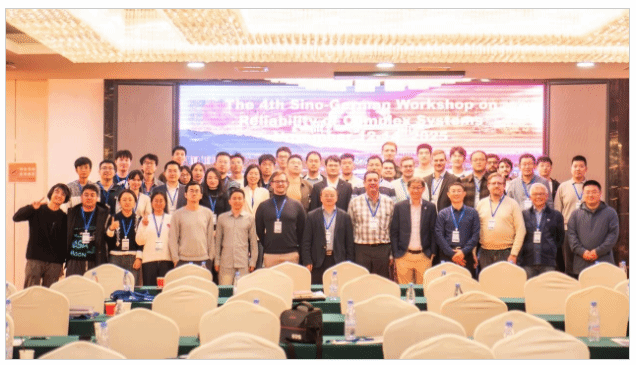
Following the registration session on the afternoon of November 12, the conference officially commenced at 8:30 AM on the 13th. Associate Professor Pengfei Wei delivered the opening address, extending a warm welcome and gratitude to delegates from around the world. He outlined the symposium's developmental history, the conference agenda, key participants, and shared insights into the collaborative vision. Following this, Professor Michael Beer delivered his opening remarks. Against the backdrop of global industrial intelligent transformation, he emphasized the strategic value of complex systems reliability research. He highly commended the series of achievements resulting from years of collaboration with the Xi'an Jiaotong-University team and expressed gratitude to the organizing committee.
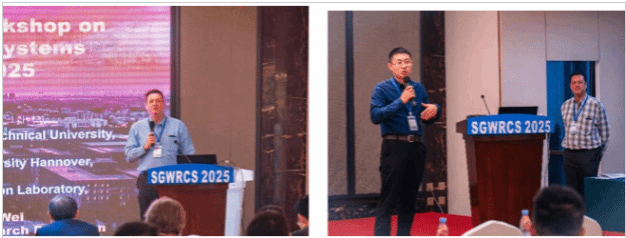
The academic session commenced with Academician Kok-Kwang Phoon's keynote presentation titled “Managing MUSIC in Geo-data.” The presentation demonstrated how machine learning and artificial intelligence technologies applied to the field of geospatial data enable engineers to transcend the limitations of personal experience and regional knowledge. By leveraging broader-scale indirect data (BID), these technologies effectively reduce uncertainty in the evaluation of design parameters.
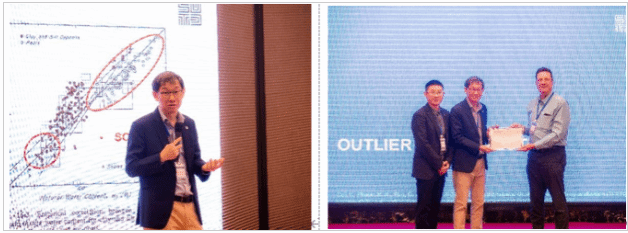
Professor Min Xie delivered a presentation titled “Managing Safety and Reliability of Complex Intelligent Systems,” emphasizing that against the backdrop of data science driving rapid advancements in various automated systems, there is an urgent need to strengthen the management of safety and reliability in complex intelligent systems during the design and development stages. He conducted an in-depth exploration of this topic through case studies in typical scenarios such as autonomous driving, robotics, and intelligent manufacturing.
Professor Matthias G.R. Faes, Director of the Institute for Reliability Engineering at TU Dortmund University, delivered a presentation titled “Importance Line Sampling for Reliability Estimation in Stochastic Linear Dynamics.” He systematically addressed the key challenges in estimating the probability of first failure in stochastic linear dynamics and proposed an efficient reliability analysis method, offering new insights for solving the reliability assessment of high-dimensional stochastic dynamic systems under extreme loading conditions.
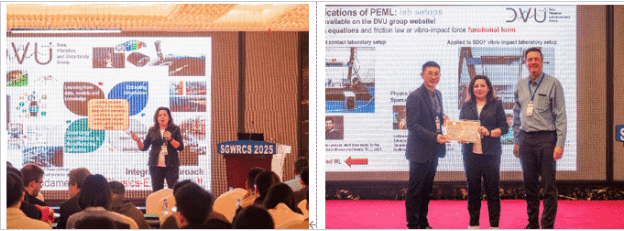
Professor Alice Cicirello, head of the Data, Vibration, and Uncertainty Research Group at the University of Cambridge, presented a paper titled “Inference and Predictions of Physical Systems under Partial Knowledge and Confounding Influences.” She introduced an adversarial decoupling learning method for constructing interpretable digital twins under conditions of partial physical knowledge and confounding factors. This approach effectively enhances the generalization capability and robustness of structural response inference and prediction.
Subsequently, several renowned scholars from home and abroad delivered outstanding academic presentations, continuously elevating the conference's scholarly atmosphere to new heights. The on-site Q&A session featured in-depth, incisive discussions that sparked extensive intellectual exchange.
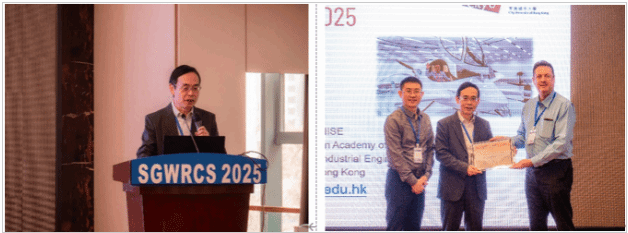
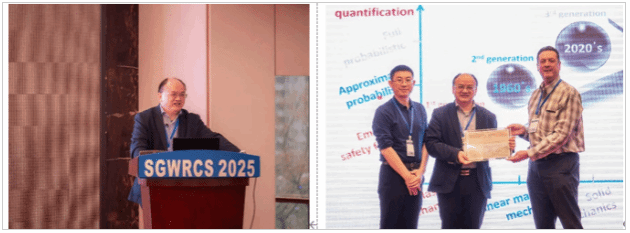
Finally, Professor Jianbing Chen delivered the closing keynote address titled “Global Reliability of Complex Structures Involving Randomness from Both Structural Parameters and Excitations via DR-PDEE.” Focusing on the quantification of structural dynamic uncertainties, Professor Chen systematically elaborated on the Probability Density Function Evolution Theory he co-developed with Academician Li Jie, along with the latest advancements by the Li-Chen School in this field. His presentation demonstrated exceptional theoretical depth, originality, and the scientific spirit of truth-seeking. With this, the entire academic session concluded successfully.
The successful convening of the SGWRCS 2025 conference marks a significant milestone in our university's collaboration with renowned German technical institutions, as well as world-class universities including the University of Cambridge, Singapore University of Technology and Design, and City University of Hong Kong. This partnership has evolved from routine cooperation to a new phase of high-quality collaboration. The conference not only deepened international academic consensus but also injected fresh momentum into reliability research for complex systems in critical fields such as aerospace. Moving forward, both parties will leverage this conference as a catalyst to continuously broaden the scope of collaboration, jointly writing a new chapter in international academic exchange and collaborative innovation!